How to teach a preschooler to trace letters, step by step
Tracing letters is often the first step toward writing. Done well, it builds pencil control, letter recognition and confidence. Done too early or too fast, it turns into frustration. This guide walks through a simple order that works for most children from about age 3 to 5.
Step 1: Check that your child is ready
Most children are ready to trace letters when they can:
- hold a crayon or chunky pencil without dropping it every few seconds,
- copy a straight line and a circle you draw,
- sit for about five minutes on one activity.
If those are still hard, spend a few weeks on scribbling, playdough and the pre-writing strokes in step 2. There is no rush: hand muscles develop at different speeds.
Step 2: Start with lines and shapes, not letters
Every letter is made of a few basic strokes: straight down, across, a circle, a slant. Practising these first makes letters much easier later.
- Draw lines from top to bottom and left to right, with a sticker at the start and finish.
- Trace big shapes. The free circle and triangle tracing worksheets are a good warm-up.
- Do a maze. The wide paths in the easy bunny maze train the same “stay on the path” control that tracing needs.
Step 3: Get the grip right, gently
A tripod grip (thumb, index and middle finger) is the goal, but don’t force it on a three-year-old. Two tricks help:
- Short crayons. Break crayons in half. A short crayon naturally pushes fingers into a better grip.
- Vertical surfaces. Tape paper to a wall or easel. Working upright strengthens the wrist and shoulder.
Step 4: Choose the right first letters
Start with capital letters made of straight lines, because they are easiest to control:
L, T, E, F, H, I first, then A, K, M, N, V, W, X, Y, Z, then curved letters like C, O, S, G and the rest.
Many children also love starting with the first letter of their own name, which is a great motivator. After capitals feel comfortable, move on to small letters.
Step 5: Trace big, then smaller
Children’s hands control big movements before small ones. Go from large to small:
- Trace a giant letter in the air with a finger.
- Trace it on a big outline letter with a finger, then a crayon.
- Trace dotted letters on handwriting lines.
- Try one on their own.
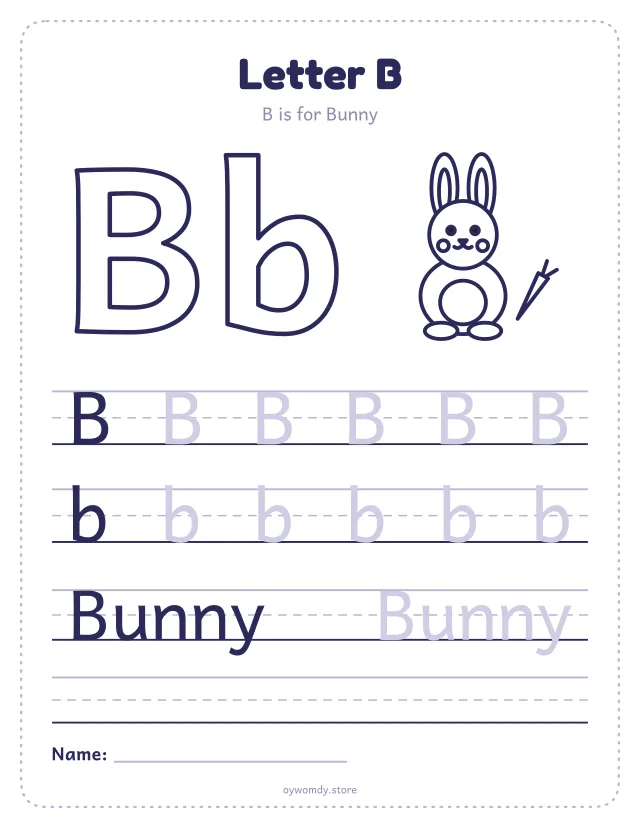
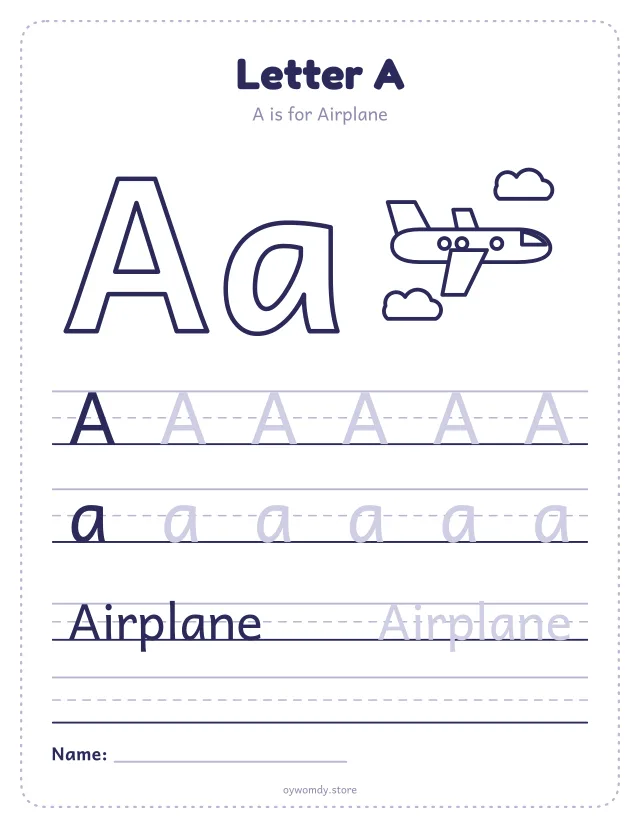
Our free tracing worksheets follow this order on one page. Each one has a big outline letter to color, rows of dotted capital and small letters, and a word to trace with a picture. Try the letter A tracing worksheet, or pick any letter from A to Z.
Step 6: Teach the starting point and direction
The most useful habit is starting each letter in the right place, usually at the top. Put a small green dot where the pencil starts and talk through the movement: “Straight down, back to the top, and across.” Saying it out loud helps children remember.
Step 7: Keep sessions short and fun
- Five to ten minutes is enough for preschoolers.
- One letter a day (or a week) is fine.
- Mix the tools: crayons, markers, a finger in sand or shaving foam, a dry-erase marker on a page inside a sheet protector.
- Praise effort, not neatness. Wobbly letters are normal for years.
A simple weekly routine
| Day | Activity |
|---|---|
| Monday | Introduce the letter and its sound, trace it in the air |
| Tuesday | Tracing worksheet, big letters only |
| Wednesday | Find the letter in a picture book |
| Thursday | Tracing worksheet, dotted letters and the word |
| Friday | Draw something that starts with the letter |
Common questions
My child holds the pencil in a fist. Should I worry? At age 3 that is very common. Offer short crayons and lots of play with playdough, pegs and stickers. Most children move to a finger grip on their own.
Should we learn capital or small letters first? Capitals are easier to form, so many children start there. Books mostly use small letters, so introduce both as soon as capitals feel comfortable.
Is tracing enough to learn to write? Tracing builds control and memory of letter shapes. After a while, children also need to copy letters and write them from memory, which comes naturally once tracing feels easy.
Free letter tracing worksheets
All 26 letters are free to download and print in Letter and A4 size on our letter tracing worksheets page. If you would like the whole alphabet in one file, the ABC Tracing Fun pack has every letter ready to print.